 Freedonia
Yesterday's SpaceX IPO: My Day as an Anti-Scam Volunteer on YouTube
Yesterday morning, Beijing time on June 12 (before SpaceX has been IPO), I opened YouTube and noticed a SpaceX livestream recommended on my homepage. Upon clicking in, I realized it was actually a highly realistic, well-disguised scam trap.
The stream claimed that Elon Musk was announcing a SpaceX IPO via cryptocurrency, inviting viewers to scan a QR code in the video to participate in the launch. Driven by curiosity to see what was actually going on, I scanned the QR code. It turned out the website was not for buying SpaceX stock with crypto at all, but rather a fake “SpaceX IPO Cryptocurrency Giveaway” event.
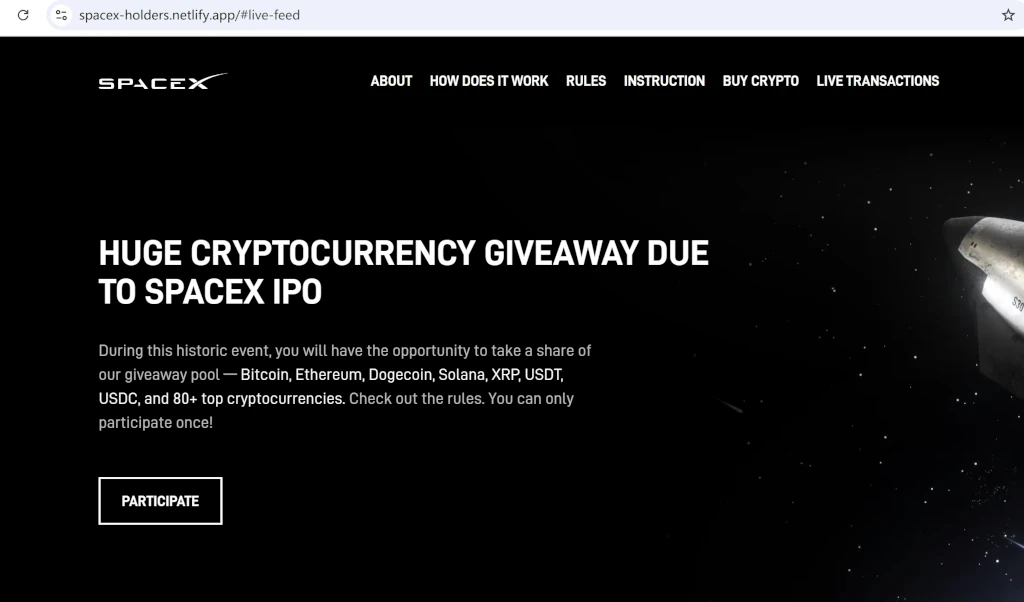
The domain name was highly deceptive: spacexholders.com (though after completing a verification step, it redirected to spacex-holders.netlify.app).
I did a quick search on Google, X (formerly Twitter), and V2EX for “buying SpaceX stock with cryptocurrency,” but found absolutely no mention of this website. Next, I ran the URL through Google AI, which immediately flagged it as a scam. A search for “SpaceX giveaway scam” turned up numerous articles detailing similar YouTube livestream scams. At this point, I was absolutely certain it was a fraudulent stream.
Looking closer, the YouTube channel was named JPMOgan.Live (ID: JPMorgan.Live-spacex), using the JPMorgan Chase logo as its avatar, yet the channel’s video history consisted of nothing but personal music uploads. There were thousands, if not tens of thousands, of active viewers, and the stream had been running for seven hours with the live chat disabled.
So I submitted a report. Within a few minutes, the channel was taken down. At the same time, I reported the phishing website to Netlify.
Around 9:00 PM, I opened YouTube again, and to my surprise, another “SpaceX IPO” livestream was recommended on my homepage. The channel was again named JPMOgan, using the JPMorgan logo, but with the ID spacex.JPMorgan. Upon clicking in, I saw the same disabled chat. Unbelievably, over 30,000 people were watching, and it had already been live for an hour. Looking through the channel’s upload history, the most recent video was from eight days ago, with content entirely in Arabic. Clearly, another hijacked channel. I immediately reported both the livestream and the channel itself.
I have to call out YouTube’s response time here—it was incredibly slow. 32 minutes after my first report, the stream was still up. I submitted another report, and it took another 20 minutes before the channel was finally banned.
Another half hour later, I received an email confirmation from Netlify stating that the phishing website had been taken down. It took nearly ten hours from my initial report to the ban, likely because their support team only started processing requests once their business hours began.
A quick search revealed that similar scams pop up every time SpaceX hosts a major live event. Articles on this date back as far as June 12, 2020, and there are multiple Reddit threads discussing these exact scams, with some users in the comments sharing that they had indeed fallen victim to them.
Below are some of the related reports and discussion links:
- Crypto Influencer Elon Musk Targeted Again! Hackers Impersonate SpaceX Channel to Steal $1.5M in Two Days
- Three YouTube Channels Hijacked for Bitcoin Scams Under the Guise of SpaceX
- Just Some Of The Crypto Scam Money Made From “SpaceX” Livestreams
- SpaceX - Musk Cryptocurrency Scam on YouTube
Meanwhile, there are already two victim reports on Chainabuse.
1 Post-Incident Reflections
The Abuse of AI Technology: These streams utilize AI-generated Deepfake videos. Today’s AI voice cloning technology is highly sophisticated; scammers clone Elon Musk’s voice and overlay it onto past event footage. Without careful scrutiny, it is incredibly difficult to realize that you are watching a Deepfake video rather than a genuine live broadcast.
Sloppy Web Development: The phishing website looked like it was thrown together quickly via “Vibe Coding.” The design was instantly recognizable as AI-generated and had glaring flaws. For instance, scanning the QR code took users to a CAPTCHA verification page, which redirected to a Netlify subdomain after verification. This sudden domain change exposed the fact that the project was hosted on Netlify. Furthermore, visiting that Netlify domain directly bypassed the verification entirely.
Classic Scam Tactics: At its core, it relies on the same old formula: “send a coin, get double back for free.” How could such a deal exist? Not to mention that blockchain transactions are irreversible; once you transfer your funds, there is no such thing as a refund. This setup reminds me of the scam ads printed on the back pages of magazines like Reader or Yilin during my childhood: “Solve a puzzle to win a prize” (they would ask a ridiculously simple question like 1+1=?, and tell you to mail in your answer along with a 10-cent coin, promising a 50 RMB reward if you got it right).
Human greed remains unchanged through the ages.